TikTok-style videos are getting their own film fest. Microdramas are series made for phones, told in episodes of one to three minutes. At October's Alza Festival in New York, each one played in a thin strip with five feet of black on either side. The only downside is you can’t scroll past.
You can now bet on the art world. Kalshi, the prediction market, has teamed up with Artnet so users can trade yes-or-no contracts on November's big New York sales. Miami Art Week is next. Finally, you can lose money on a masterpiece without buying it.
Jensen Huang’s viral fit was an AI fantasy. After the former NVIDIA CEO admitted to an affair with a Chinese executive reportedly suspected of spying, a photo of him in a studded Saint Laurent jacket went viral. It was AI, edited onto a June picture of him in Dior. He’s due before Congress on December 1, which means there’s still time for him to buy one.
Maybe. Maybelline. Went. Too. Far. The brand’s new Miley Cyrus campaign gives its familiar slogan a punctuation makeover: “Maybe. We’re born with it. Maybe. It’s Maybelline.” The brand’s president says the old line was “giving ambiguity.” The new one’s giving hiccups.
GTA VI’s research involved clubbing and cops. In 2015, Rockstar developers stayed out in Miami clubs until 4 a.m. and rode along with South Beach cops. Almost 5,000 people then built Vice City, down to the insides of the fridges. Florida Man is getting a glow-up.
Damienciaga is here. For the 25th birthday of Balenciaga's Le City bag, shock artist Damien Hirst covered it in his spots, butterflies and pill stickers. The designs spill onto sneakers and bomber jackets too. Hirst once preserved a shark in formaldehyde. Now he's preserving the 2000s.
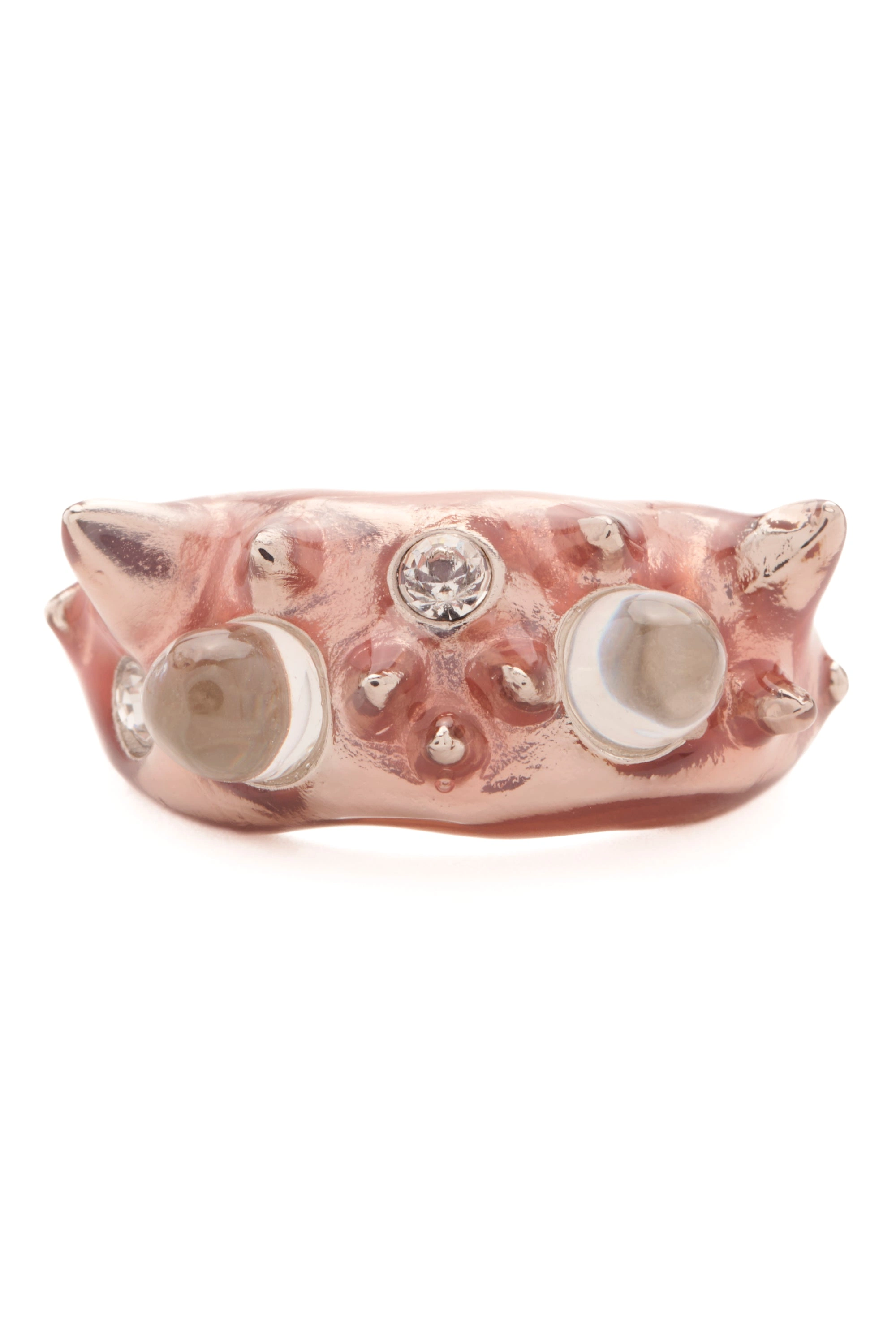
For most of the 2010s, everything looked like it came out of the same mood board: a tidy sans-serif logo, millennial pink, a beige couch. Suddenly, searches for “aliencore” are up 80%, and the stuff in our feeds suggests the truth is out there. Glowing green glass lamps, spiky enamel rings, wraparound sunglasses with a warped logo.
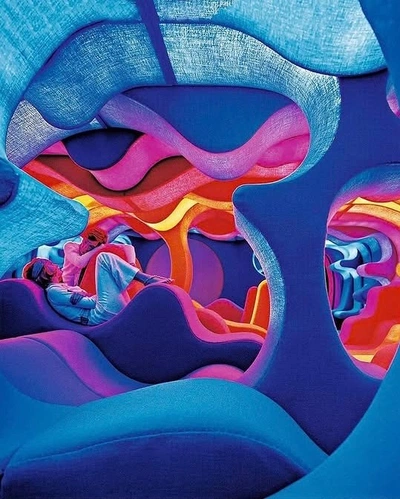
In 1970, the chemical company Bayer rented a boat during the Cologne furniture fair and hired the Danish designer Verner Panton to turn it into a showroom. He built Fantasy Landscape, a room of curving, organic shapes in saturated color. It looked like the inside of another planet, and it was there to sell synthetic materials.
Not all aliens want the same thing. Some want to survive. Others want to sell plastic. But most of them are just trying to find a way home.
The clean look didn't age well. Brent David Freaney, who designed the art for Charli XCX's Brat, called it "the Sweetgreenification of Manhattan." "Everything was designed to look like an app," he told the New York Times. Now, the Times says, that look "reeks of venture capital funding, or worse, artificial intelligence." As one creative director put it, "The worse it looks, the better it performs."
Panton would get it. For his 100th birthday, the Vitra Design Museum is showing a walk-in reconstruction of Fantasy Landscape until May 2027.
Some of the strangest shapes have practical roots. Joris Laarman's 2006 Bone Chair looks grown, but it was designed with car-parts software from Opel, then General Motors’ German subsidiary. The program copies how bones grow, putting the most material where there's the most stress.
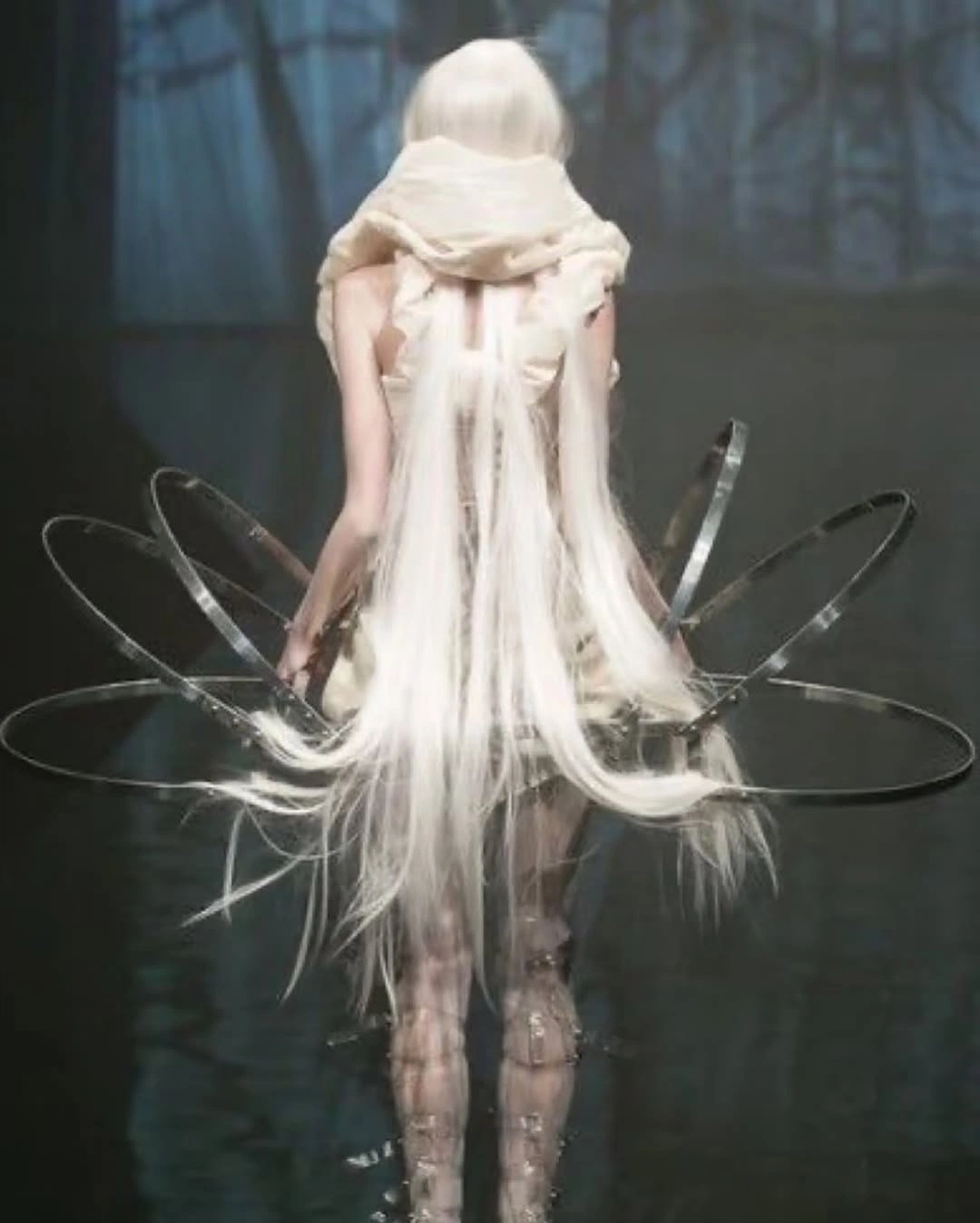
Fashion took the idea onto the body. Thierry Mugler's 1997 couture show, Les Insectes, was known for its "Fly" sunglasses, molded from a single piece of Plexiglas. Alexander McQueen's final runway show, Plato's Atlantis, imagined humans evolving to survive rising seas. Models wore face prosthetics and 25 cm "Alien" heels inspired by H.R. Giger.
Giger, who designed the creature in Alien, also built a bar. It opened in 2003 inside a 400-year-old castle in Gruyères, Switzerland, with vertebrae arching across the ceiling and chairs crowned with pelvic bones. They're called Harkonnen chairs.
Dune: Part Two looked to Giger again for Feyd-Rautha's costumes. Its production designer based the Harkonnen planet on black plastic septic tanks, partly because of "what's actually inside." The planet's outdoor scenes were shot in infrared, which is why everyone there looks so pale.
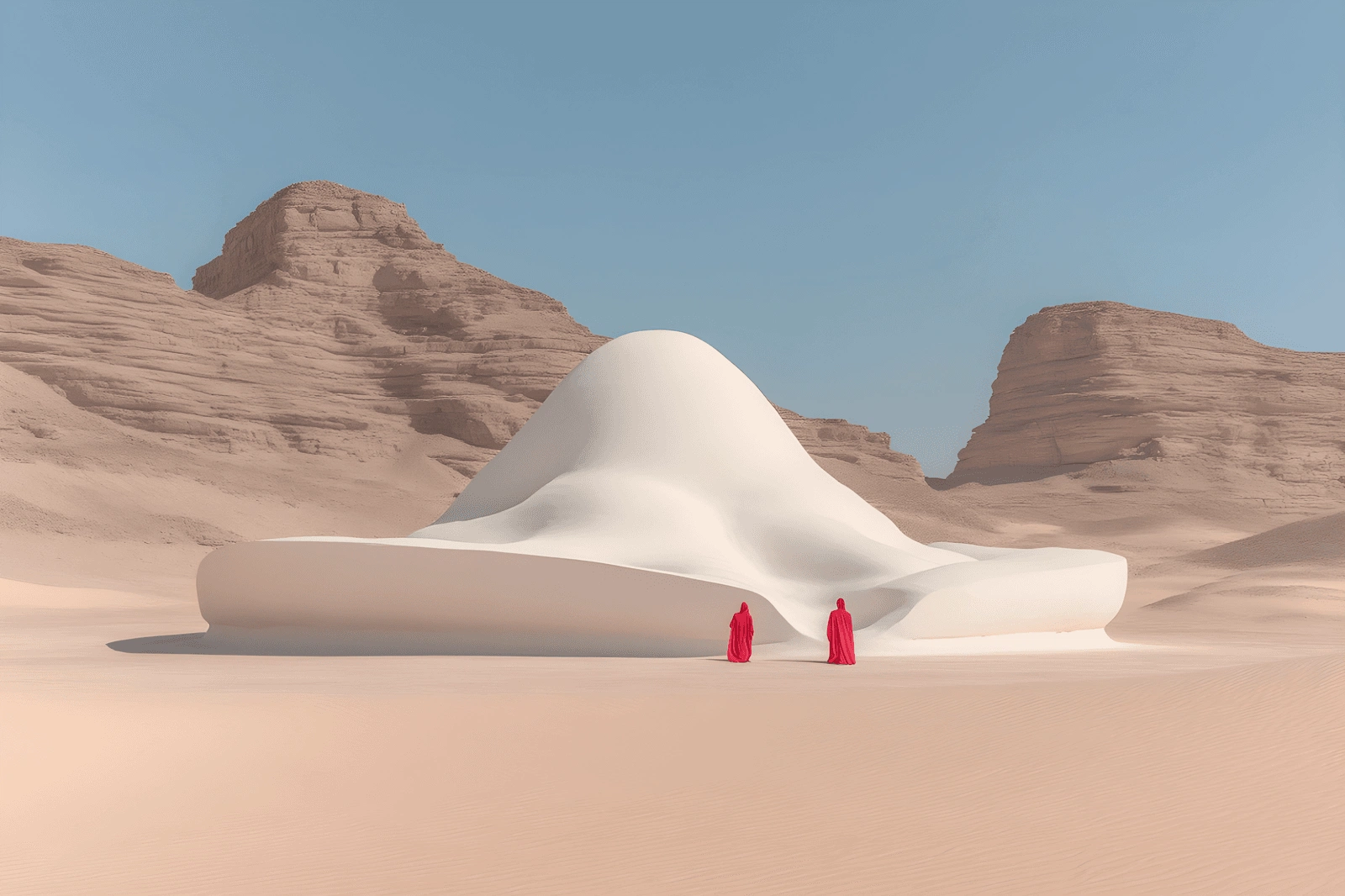
For some Arab artists, the alien means something closer to home. In Larissa Sansour's film A Space Exodus, she plays the first Palestinian in space: "a small step for a Palestinian, a giant leap for mankind." Kuwaiti artist Aseel AlYaqoub made a sculpture in the AlUla desert about desert varnish, a colorful mineral coating on rocks that has puzzled scientists for two centuries.
"For me, the alien was never something that needed to be invented or imported from science fiction," she told AD Middle East. "It was already here, embedded in the desert landscape, familiar in appearance yet fundamentally strange once examined closely."
Saudi designer Muotaz Abbas often uses AI, but he made his chair TR03 the hard way: 300 sheets of stainless steel, welded over eight months in Italy. It weighs 150 kg. He had it carried up a sand dune in the Riyadh desert, paid the crew triple, and still ended up helping.
GRAU's Alien lamp is glowing green glass on polished aluminum, limited to 200. Collina Strada's Demi Alien ring is spiky, hand-enameled pewter. La Manso's acid-green Alien & Trapper ring was made, its listing says, "to commemorate and heal our inner rebel teenager."
We spent a decade trying to make everything look as clean as possible. Now, we're looking for something a little more out-there.
On starting with fabric, writing by hand, and the Alice Coltrane record that’s watched over the shop since day one.
A moment with
Tal Silberstein
On starting with fabric, writing by hand, and the Alice Coltrane record that’s watched over the shop since day one.
Before Colbo, Tal Silberstein ran a little record shop that also sold magazines, ceramics, scents and, eventually, clothes he made himself. From DJing, throwing events and working with designers, he learned how a space can bring people together. Colbo, which means "everything in it", opened on the Lower East Side in 2021. Today there's the clothing shop on Orchard, a wine bar called Next Door on Allen, a spot at ESTNATION in Tokyo and an LA pop-up through the end of the year. People come for a shirt and stay for a glass of wine. Here, he talks about the label’s five-year anniversary, why the best pieces start with the fabric, and the Alice Coltrane record that's watched over the counter since day one.
What’s been going on at Colbo recently?
We're celebrating five years of Colbo and one year of Next Door, our wine bar, November 19–22. It'll be a long weekend of music, food, friends and a holiday capsule we made for the anniversary.
We've also extended our LA pop-up on N Virgil, next to our good friends at Courage Bagels, through the end of the year! It's been exciting to see how Colbo feels in another city and to get to know the community there.
We also just released Sirah, a new silhouette we developed with our longtime collaborator Sperry.
And we just wrapped a collab with Artforum for their inaugural Art Week: a small capsule that's available in store, online, in LA and at the New Museum, plus a site-specific exhibition across both our NY spaces.
So, there's a lot happening at once, as usual! + more to come ;)
Tell us your favorite products from your recent collection
The Chinos in Soft Dark Brown. One of my favorite pairs of pants. They're loose and easy, in an Italian linen and wool blend that we also used for a matching blazer. I love them as a suit or just worn casually.
The Suit Overcoat. It's been my everyday winter coat for the last few years, and this season we made it in a Tumble Greige. The washed wool has that familiar, already-worn feeling I love. It's tailored and oversized at the same time, so there's room to wear it over everything.
The Mel Jacket. It's a relatively new shape for us, with some really cool flaps, vents and athletic details, like the elastic cuff and thumb hole, but made in the most unique fabrics we could source. Kind of our take on tech.
Tell us about the history of Colbo. What inspired you then vs. now? Give us some brand lore!
Colbo means "everything in it", and that's what it is. Everything I've experienced so far and feel the urge to share: music, clothes, hospitality, community and art, all in one place.
After traveling the world and studying art in New York, in 2015 I opened a little record shop called BVRLY, with magazines, ceramics, scents and eventually clothes I started making. At the same time I was working with Hed Mayner, DJing and throwing events. Later, being part of Public Records in Brooklyn showed me how far that idea could go.
Colbo came out of all of that in 2021, on the Lower East Side. Now there's the shop on Orchard, Next Door on Allen, our space at ESTNATION in Tokyo, and a team that believes in it as much as I do and keeps pushing forward!
We’re building a world more than a brand. A little bit of a cult, in the best way.
Tell us more about your creative process.
I usually start with fabric. I'll find a texture, color or treatment that interests me and start thinking about what it could become. Sometimes it fits into a shape we've been working on; sometimes it calls for something completely new, and sometimes it goes the other way and a shape sends me looking for the right fabric.
It's always very intuitive and physical. I need to touch things, try them on and see how they move. I might love each piece on its own, but the feeling comes from what I put next to it. I think about clothes, music and spaces in a similar way.
Ideas can come from anywhere. Traveling, meeting people, going to dinner, just things that happen over the course of a day. I'm also really drawn to the past, to vintage clothes and older ways of living and spending time. Nature and spirituality are always in there too. I like seeing how those feelings come through in the clothes and spaces we're making now.
Which three places have inspired you?
India, where I spent over a year traveling when I was young. That time opened up a lot for me around spirituality, music, energy and different ways of living and dressing.
Milan. To me it's the coolest, most unassuming city. Naturally stylish and chic, the best food and amazing people. All of Italy, really. Super inspiring, from the culture and fashion to the aesthetics, nature, lifestyle and beyond.
The desert. You can probably see it in my color palette, lol, but it's also where I feel deeply calm. There's so much space, tonality, structure and silence. It feels like a place for the spirit, somewhere I can meditate, reconnect and get inspired.
What do you listen to on repeat?
Alice Coltrane is someone I always return to. Her music has this deep, meditative quality that's been part of my life and Colbo from the beginning. We've had one of her records above the counter since day one, just watching over the space. Otherwise, my listening goes in a lot of directions, from jazz and ambient/electronic to soul, reggae, post-punk and beyond.
What’s a daily ritual that shapes the way you work?
Every morning I write out all my to-dos with a pencil on paper, across everything I’m working on. I redo the list the same way every day. It’s the only way I can keep track of everything. I think writing things by hand helps them stick in memory and become ingrained in the brain.
I’ve also used my own handwriting in a lot of Colbo’s graphics over the years, and I still do. It’s something I’ve used in other projects in the past too.
Who is your forever inspo?
Giorgio Armani. There's something so beautiful about clothes that have that much thought behind them and still feel completely relaxed on a person. I keep coming back to his proportions, fabrics and colors, and to the ideas and campaigns that built the brand over the years.
Object Love
Sundae Set
Service Projects' Ice Cream Cup 02 is shaped like an hourglass: a wide, shallow cone of brushed stainless steel balanced on a smaller one. Fine ridges circle both halves and catch the light like the grooves of a record. The matching Canteen teaspoon has a handle fluted like a Greek column. Both were designed by Laura Bilde, who was named upcoming designer of the year at the Danish Design Awards in 2016.
Service Projects started in New York in 2022 with the idea of bringing restaurant-kitchen steel home, and it now works out of Copenhagen. The brand says the line was inspired by ancient architecture, a surprisingly sophisticated setting for a scoop of ice cream. Sure, we may put away childish things, but the post-meal sweet tooth is eternal.